

Rethinking Your Portfolio for 2026


Rethinking Your Portfolio for 2026
Brendan Greenwood BCom, CFP, CIM, | January 20, 2026
As we look ahead to 2026, many market observers believe the investment landscape is shifting. Inflation is more persistent, government debts are rising, and the global role of the US dollar is slowly shifting. These changes don’t require drastic action, but they do require thoughtful portfolio adjustments.
What is De-dollarization?
The US dollar remains the world’s most widely used currency, but new pressures are emerging. The US Deficit is growing at a pace normally only seen during recessions or major crises. This is happening because:
The shortfall between US Government spending and tax revenues continues to grow faster than the growth in the underlying economy
Interest costs on existing debt remain stubbornly high
Spending cuts are politically difficult and unpopular
To fund this gap, increasing amounts of government debt continue to be issued, and that debt must be absorbed by investors in the US and around the world.
Less US Government Debt is Being Bought and Held by Foreign Central Banks
For decades, foreign governments regularly bought large amounts of US government bonds (US treasuries). That steady demand helped reduce US interest rates and support the US dollar. This is starting to change. Many countries are no longer running large trade surpluses, meaning they have less excess capital to invest in US debt.
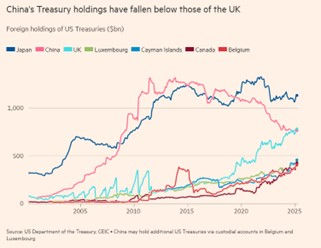
The two largest foreign holders of US debt, China and Japan, are choosing to hold a smaller share of their reserves in US treasuries and more in gold and sovereign debt from other developed countries.
US institutions also are reducing their US Government Debt
The largest owners of US treasuries are American financial institutions. The Investment and pension funds they manage reflect a lot of that demand. These funds are starting to shift their asset allocation over concerns that US issued debt will not be able to provide a real rate of return after adjusting for inflation and the potential devaluation of the US dollar. Medium and long-term bonds are particularly vulnerable to inflation, as their longer fixed payment stream is more exposed to the loss of purchasing power in an environment of rising government debt and persistent deficits.
What does this mean for the future outlook of the US dollar?
This is not an abrupt shift, and it does not mean the US dollar is losing its global role. However it may indicate that the system is less reliant on automatic buyers, which can lead to higher interest rates and more currency volatility over time, bad for mid and long duration bonds. We may see a weaker US dollar in the future with fewer buyers of US Government debt.
Why Bonds and Cash Deserve a Second Look
Many investors think of bonds and cash as the “safe” parts of a portfolio. They can reduce market swings, but they could also carry a quieter risk, inflation and devaluation over time.
Bonds provide fixed payments. When the cost of living rises, those payments may not stretch as far as expected. Bonds can still provide some protection in a portfolio, but investors should be cautions when evaluating their medium to long-term exposure.
Cash feels secure because its value doesn’t fluctuate. But inflation slowly reduces what that cash can buy. A simple way to think about it: Cash and bonds may help protect against market volatility — not against rising prices.
Elevated Markets Mean Diversification Matters More
Equity markets have performed very well in recent years, especially in large growth and technology stocks. Strong companies can still experience sharp pullbacks when valuations are stretched, projected earnings growth fails to materialize and interest rates remain persistently high.
This makes it important not to rely on a single source of return.
Owning more investments doesn’t automatically reduce risk, what matters is owning investments that respond differently to each other when economic conditions change.
Protect Your Investment Portfolio Value by Focusing on Real Returns in 2026
A real-return approach to investing aims to help reduce volatility (risk) and maintain real growth above inflation by reducing dependence on any one market outcome.
This may include exposure to:
Market neutral, long short and options strategies designed to perform in both rising and falling markets
Income-focused approaches that emphasize consistency
Gold and real assets that can help preserve purchasing power
Value-oriented investments priced more conservatively
International and emerging market exposure to reduce reliance on one economy or currency
As illustrated by Harry Markowitz, who pioneered modern portfolio theory, this approach to portfolio construction is intended to help manage risk through diversification and, over time, may improve risk-adjusted return outcomes. The goal is not to predict downturns, it’s to build portfolio resilience.

Our Perspective
Inflation, rising government debt, global economic and geopolitical shifts are happening more quickly in the world today and their impact on long-term wealth can be significant.
The world is changing. Portfolios built for the way the world was, may need adjustment in anticipation for the future that is unfolding. Properly diversified investment portfolios designed with inflation awareness, different uncorrelated return streams, and currency resilience may be better positioned, to support long -term wealth accumulation over time, particularly in an increasingly challenging and uncertain world.

Brendan Greenwood is an Investment Advisor and Financial Planner with Worldsource Wealth Management Inc. focused on improving the lives of his clients and their families through holistic planning. He specializes in tax advantaged personal pension strategies and leveraging technology to provide progressive institutional style investment solutions for professionals, business owners, retirees and their families.
For other articles written by Brendan Greenwood visit his Blog | GreenwoodWealth
Book a discovery meeting with Brendan here: https://calendly.com/greenwoodwealth to see if we can help.
*Insurance solutions and related services mentioned in this newsletter as part of comprehensive financial planning services only and are not available through Worldsource Wealth Management Inc. Investments products and services are provided by Brendan Greenwood through Worldsource Wealth Management Inc., the sponsoring dual-registered dealer, operating as both a mutual fund dealer and an investment dealer is a Member of the Canadian Investor Protection Fund (CIPF) and of the Canadian Investment Regulatory Organization (CIRO).
Investing involves risk. Equity markets are volatile and will increase and decrease in response to economic, political, regulatory and other developments. The risks and potential rewards are usually greater for small companies and companies located in emerging markets. Bond markets and fixed-income securities are sensitive to interest rate movements. Inflation, credit and default risks are all associated with fixed income securities. Diversification may not protect against market risk and loss of principal may result. Commissions, trailing commissions, management fees and expenses all may be associated with investing in exchange-traded funds (ETFs). Please read the relevant prospectus before investing. ETFs are not guaranteed, their values change frequently and past performance may not be repeated.
This material has been prepared for informational purposes only and should not be considered personal investment advice or solicitation to buy or sell any securities. As well, it is not intended to provide, and should not be relied on for, tax, legal or accounting advice. It may include information concerning financial markets as at particular point in time and is subject to change without notice. Every effort has been made to compile it from reliable sources, however, no warranty can be made as to its accuracy or completeness. Investors should seek appropriate professional advice before acting on any of the information here. The views expressed here are those of the authors and writers only and not necessarily those of Worldsource Securities Inc., its employees or affiliates. There may also be projections or other "forward-looking statements." There is significant risk that forward looking statements will not prove to be accurate and actual results, performance or achievements could differ materially from any future results, performance or achievements that may be expressed or implied by such forward-looking statements and you will not unduly rely on such forward-looking statements. Before acting on any of the information provided, please contact your advisor for individual financial advice based on your personal circumstances.


Comments